

Is It Damp or Just Condensation? How to Tell the Difference (And Save Hundreds)
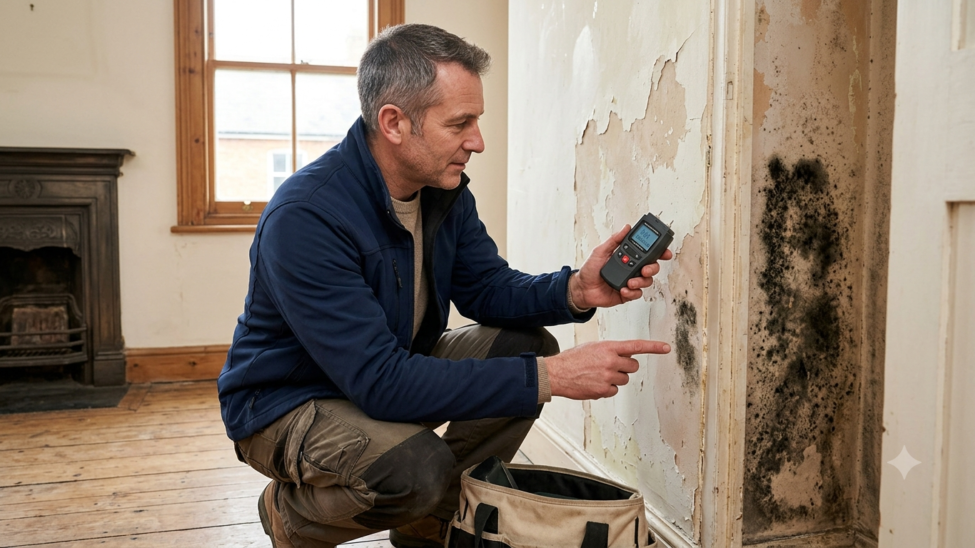
You walk into your spare bedroom or look behind the wardrobe, and there it is: a patch of dark, fuzzy black mould or a damp, cold spot on the plaster.
Instantly, your mind jumps to the worst-case scenario. You start worrying about rising damp, failing damp-proof courses, and expensive building contractors tearing up your floorboards.
But here is a secret that damp-proofing companies rarely want you to know: up to 75% of the “damp” issues we inspect in Wiltshire aren’t damp at all—they are simply condensation.
Misdiagnosing condensation as rising damp is one of the most expensive mistakes a homeowner can make. If you pay thousands to inject chemicals into your walls when the real culprit is poor airflow, the mould will return, and your money will be gone.
Here is how you can tell the difference between condensation and structural dampness before you call in the professionals.
1. The Visual Clues: What Does the Damp Look Like?
The easiest way to start your investigation is simply by looking at the characteristics of the damp patch and the mould itself.
If It’s Condensation:
- Black Spotty Mould: Condensation almost always brings Aspergillus niger (black toxic mould). This mould feeds on the pure, clean water vapor that condenses on cold surfaces.
- Location, Location, Location: Condensation is highly selective. It loves cold spots on walls, corners where air doesn’t circulate (like behind wardrobes or sofas), around window frames, and on cold external walls.
- No “Tidemark”: Condensation patches are often patchy, widespread, or high up on walls and ceilings.
If It’s Rising or Penetrating Damp:
- Staining and Salt Tidemarks: True damp carries ground salts or minerals from rainwater through the brickwork. When the water evaporates, it leaves a brown, yellow, or powdery white “tidemark” on your wallpaper or plaster.
- No Black Mould: Believe it or not, black mould rarely grows on areas affected by true rising damp. The ground salts in the water act as a natural fungicide, making the wall too salty for mould to survive.
- Low Down: Rising damp will rarely travel higher than 1 meter above the ground floor level.
2. The Simple DIY “Foil Test”
If you have a damp patch on a wall and you aren’t sure whether the moisture is coming from inside the room (condensation) or outside through the brickwork (penetrating/rising damp), try this quick, zero-cost test:
          THE 24-HOUR FOIL TEST

   [ Wall ] <--- Dry the damp patch completely with a hairdryer.
   [ Wall ] <--- Tape a square of kitchen foil tightly over the area.
   [ Wall ] <--- Leave it sealed for 24 to 48 hours.
- The Result: Peel the foil off.
- If the front of the foil (the side facing the room) is wet, the moisture is condensing from the air in the room. Diagnosis: Condensation.
- If the back of the foil (the side touching the wall) is wet, moisture is seeping through the brickwork from the outside. Diagnosis: Penetrating or Rising Damp.
Condensation vs. True Damp: A Quick Comparison
| Feature | Condensation | Rising / Penetrating Damp |
| Primary Cause | High humidity and poor ventilation | Leaking pipes, high ground levels, roof leaks, or no DPC |
| Mould Type | Heavy black spotty mould | No mould (usually powdery white salt crusts) |
| Sensation | Wall feels cold and slightly damp to the touch | Plaster is visibly wet, crumbling, or wallpaper is peeling |
| Typical Fix | Improved airflow, extractor fans, consistent heating | Fixing external defects, clearing air bricks, lowering soil levels |
Why Getting It Wrong Is So Costly
If a damp-proofing salesman walks into a room with heavy black mould, they may still try to sell you a chemical damp-proof course. They might claim the wall is damp (which it is, on the surface) and that their barrier is the only solution.
But injecting chemicals does absolutely nothing to stop warm, wet air from hitting a cold wall.
If you have condensation, the solution is almost always free or very low-cost. It involves managing how you dry clothes indoors, ensuring your bathroom and kitchen extractor fans are running correctly, and keeping a consistent ambient temperature in your home.
Stop Guessing. Let us Diagnose It Accurately.
If you are struggling to clear a damp issue, or if you are in the process of buying a property in Swindon, Devizes, Marlborough, or Salisbury, don’t rely on guesswork or biased contractor quotes.
At Wiltshire Damp Survey, we are fully independent. We do not sell damp proofing, plastering, or chemical treatments. Our only job is to use advanced diagnostic tools—like thermal imaging, environmental data loggers, and deep-wall moisture meters—to tell you exactly where the moisture is coming from.
Save yourself thousands in unnecessary building work.
Contact Wiltshire Damp Survey today on 01793 238738 or email paul@wiltshiredampsurvey.co.uk to book your completely unbiased diagnostic damp assessment.