

Why Most “Rising Damp” Quotes Are Misdiagnosed (And How a £0 Contractor Proposal Could Cost You Thousands)
If you are buying a home or managing a property in Wiltshire and a surveyor or contractor has flagged “suspected rising damp,” take a breath before booking a chemical wall-injection crew.
In the UK damp-proofing industry, misdiagnosis is common. Hundreds of homeowners across Swindon and Wiltshire spend thousands of pounds on aggressive remedial damp-proofing treatments every year—only to find the damp returns months later.
The problem isn’t always that contractors are bad at their jobs; it’s that a free contractor survey is designed to sell building services, not diagnose problems.
The Core Problem: Contractors vs. Independent Surveyors
To understand why misdiagnosis happens so frequently, it helps to look at the business models:
- Remedial Contractors: Make their income by installing chemical damp proof courses (DPC), tanking, and plastering. When they give you a quote, their primary goal is to sell a product or service.
- Independent Damp Surveyors: Do not sell remedial treatments. We sell accurate, unbiased diagnostic answers. Our only incentive is to find out exactly what is causing the moisture so you can resolve it as efficiently and cost-effectively as possible.
4 Common Culprits Misdiagnosed as “Rising Damp”
True rising damp—where moisture moves upward through brickwork from the water table—is far less common than people think. In the vast majority of Wiltshire properties, ground-level moisture issues are caused by basic external or internal defects:
1. High Ground Levels Bridging the DPC
Over decades, garden beds, patio slabs, or gravel pathways get built up above the original Damp Proof Course. Water simply bridges over the DPC and enters the inner wall.
- The fix: Lowering the ground level or installing a French drain—not injecting chemicals into the brickwork.
2. Blocked Air Bricks & Poor Sub-Floor Ventilation
Suspended timber floors require air movement underneath to keep joists dry. When soil, debris, or modern extensions block sub-floor vents, trapped humid air leads to floor rot and wall moisture.
3. Penetrating Damp from Building Defects
Leaking gutters, cracked render, damaged roof flashing, or porous brickwork allow rainwater to soak inward.
4. Condensation & Poor Indoor Air Circulation
Warm, moist air created by modern living condenses on cold lower walls, producing localized damp patches and black mould.
How We Diagnose the Real Problem
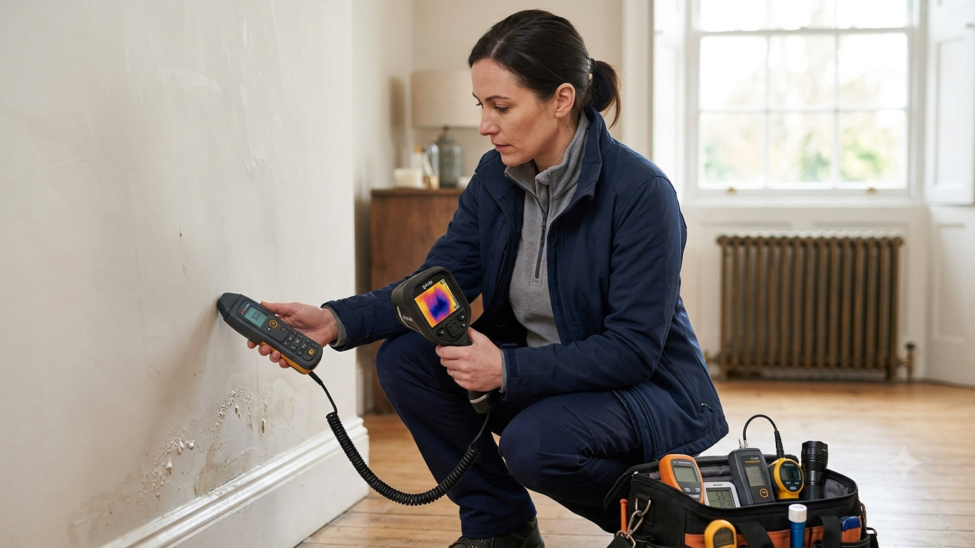
At Wiltshire Damp Survey, we use specialist diagnostic techniques to inspect your property inside and out:
- External Inspection: Checking roofs, flashing, gutters, pointing, render, ground heights, and sub-floor ventilation.
- Thermal Imaging Cameras: Identifying hidden temperature variations that signal water paths or cold spots.
- Deep Moisture Profiling: Measuring sub-surface moisture and relative humidity levels rather than relying on misleading surface pin meters.
- Timber Checks: Inspecting floor structures for wet rot, dry rot, or woodworm activity.
Pre-Purchase Surveys: Don’t Negotiate Blindly
If your HomeBuyer report flagged dampness on ground floor walls, an independent Pre-Purchase Damp & Timber Survey gives you crucial evidence before exchanging contracts:
- Renegotiation Power: Written proof of actual repairs needed so you can adjust your purchase price.
- Protection Against Overpaying: Knowing whether a problem requires £2,000 in plastering or just £150 in gutter repairs.
- Peace of Mind: Complete confidence in the structural condition of your prospective home.
Get Honest, Independent Advice Today
Stop guessing and avoid paying for unnecessary chemical treatments. With over 20 years of local diagnostic experience across Swindon and Wiltshire, Wiltshire Damp Survey gives you clear answers you can trust.
- Call Paul directly: 01793 238738
- Email: paul@wiltshiredampsurvey.co.uk
- Website: wiltshiredampsurvey.co.uk