
Finding Damp in Your Wiltshire Home? Why You Should Avoid “Free” Surveys
If you have recently spotted a dark patch of mould in your Swindon home, or had a surveyor flag “suspected damp” during a pre-purchase valuation elsewhere in Wiltshire, your immediate reaction might be panic.
It is easy to imagine crumbling walls, major structural decay, and a massive bill to match. Naturally, you search for a solution and quickly find dozens of contractors offering “free” damp surveys to diagnose the problem.
But before you invite a contractor into your home, it is important to understand why your home might not actually need a chemical damp-proof course—and how a “free” survey could cost you thousands.
The Conflict of Interest in “Free” Damp Surveys
In the home preservation industry, the word “free” usually comes with a major catch. Contractors offering free surveys do not make their money by diagnosing problems; they make their money by selling the cure.
Because they have a direct conflict of interest, their goal is often to recommend expensive remedial work—such as injecting chemical damp-proof courses or hacking off plaster—regardless of whether your home truly needs it.
True rising damp (where moisture travels up from the ground through capillary action) is actually quite rare. More often than not, the damp patches on your walls are caused by simple, external maintenance issues or modern ventilation defects that do not require invasive chemical treatments.
Three Common Culprits of “Damp” That Aren’t Rising Damp
When we carry out independent inspections across Wiltshire, we frequently find that moisture issues are down to simple structural bypasses or lifestyle habits, rather than a failure of the damp-proof course:
- High Ground Levels: Over the years, soil, garden beds, patios, or pathways get built up too high outside. If these rise above your property’s existing damp-proof barrier, moisture can bridge directly into your internal walls. Lowering the ground level is often all it takes to solve the issue.
- Poor Sub-Floor Ventilation: If air bricks are blocked by modern patios or dirt, humid air gets trapped beneath your floorboards. This trapped moisture quickly leads to timber decay and dampness. Simply clearing the air bricks can restore airflow and dry out the space.
- Condensation Imbalances: Modern living generates a massive amount of moisture. An average family of four releases up to 10 to 15 litres of water vapor daily just from cooking, bathing, and drying clothes. In modern, tightly sealed homes with double glazing, this moisture cannot escape, settling on cold walls and creating fuzzy black mould.
Why Period Properties in Wiltshire Need to “Breathe”
Wiltshire is famous for its beautiful historic architecture, ranging from timber-framed Tudor cottages to classic red-brick Victorian terraces in Swindon and grand stone homes in the Cotswold borders. However, these traditional properties (generally built before 1919) behave completely differently than modern homes.
While modern homes rely on a “barrier system” (plastic membranes and cavity walls) to keep moisture out, historic homes rely on breathability. They were built using porous materials like lime mortar, soft red brick, and local stone, which naturally absorb moisture and harmlessly release it back into the atmosphere.
Damp issues in these period homes almost always start when modern, non-breathable materials are used. Replacing traditional lime mortar with modern cement pointing, or coating walls in gypsum plaster, traps water inside the brickwork. Injecting chemicals into these historic walls often exacerbates the issue rather than fixing it.
Why an Independent Diagnostic Survey Saves You Thousands
This is where an independent damp survey makes all the difference. At Wiltshire Damp Survey, we are completely independent specialists. We do not sell damp-proofing products, chemical treatments, or building works.
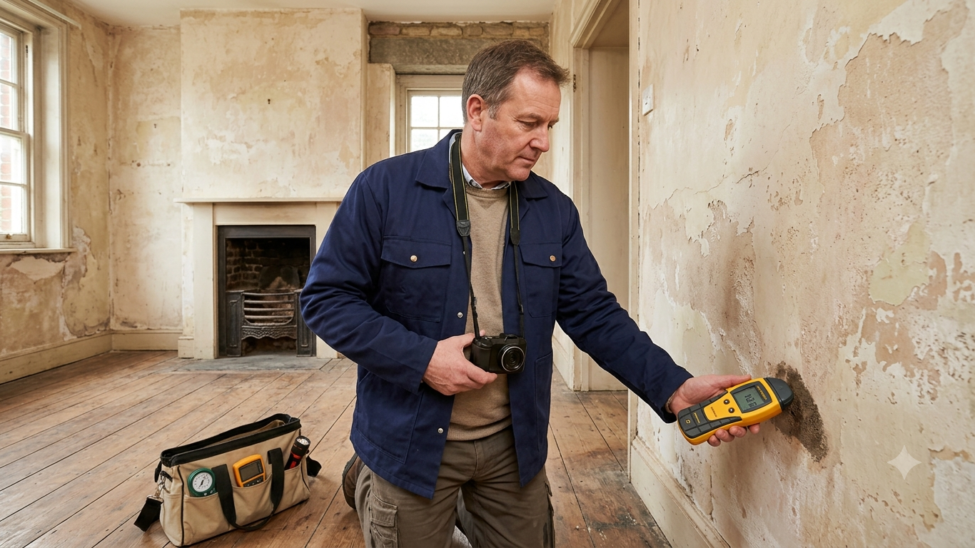
Because we have no financial interest in recommending repairs, our only goal is to find the absolute truth. Acting as property detectives, we use non-destructive diagnostic tools—including thermal imaging, hygrometers, and moisture mapping—to trace the damp back to its source.
In a vast majority of cases, we are able to save homeowners, landlords, and property buyers thousands of pounds by pointing them toward simple, cost-effective, and sympathetic solutions.
Stop Guessing. Get the Facts.
Whether you are in the middle of buying a home in Swindon and need a pre-purchase damp survey, or you are a homeowner trying to get rid of mould in a period property, don’t let a sales representative dictate how you treat your home. Get an honest, unbiased assessment from a specialist who has nothing to sell you but the truth.
Are you worried about damp in Wiltshire or the South West? Contact Wiltshire Damp Survey today on 01793 238738 or email paul@wiltshiredampsurvey.co.uk to book your independent diagnostic survey.