

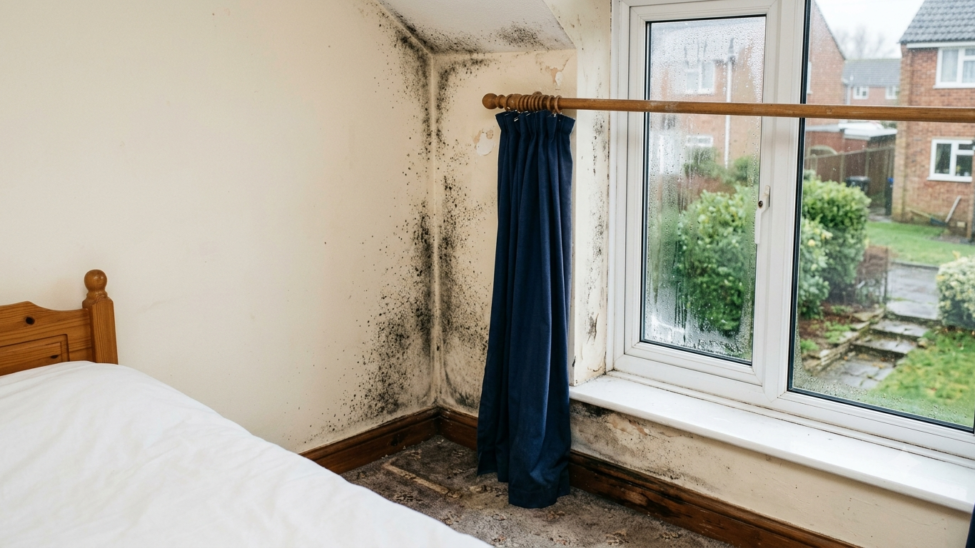
Is It Damp or Just Condensation? How to Tell the Difference (and Save Money)
When you wake up in the morning and see water droplets pooling on your windowsills or find fuzzy black spots appearing in the corners of your ceiling, your immediate thought is likely: “Oh no, my house has damp.”
In a way, you are right—condensation is a form of dampness. But it is vastly different from structural damp like rising damp or penetrating damp.
Understanding the difference between structural moisture issues and atmospheric condensation is one of the easiest ways to save yourself thousands of pounds in unnecessary building repairs. Let’s look at how to tell them apart and how to reclaim your walls.
What is Condensation, and Why Does It Happen?
Condensation occurs when warm, moisture-rich air inside your home collides with a cold surface (like an external wall, a window pane, or a tiled bathroom surface). When the warm air cools down rapidly, it can no longer hold the moisture, so it releases it as water droplets.
An average family of four releases up to 10 to 15 litres of water vapor into the air every single day simply by cooking, showering, drying clothes indoors, and breathing.
If that moisture cannot escape, it will settle on the coldest surfaces in your home. Over time, these constantly damp areas become the perfect breeding ground for toxic black mould (Aspergillus or Stachybotrys chartarum).
How to Spot the Difference: Condensation vs. Structural Damp
When we conduct inspections across Wiltshire, we often find homeowners who have been quoted for rising damp treatments when their actual problem is 100% condensation. Here is how you can tell them apart:
1. Look at the Pattern of the Mould
- Condensation: Usually shows up as speckled black or dark green mould. It thrives in stagnant air corners, on ceilings, behind wardrobes pushed against external walls, or around window frames.
- Rising/Penetrating Damp: Rarely produces black mould on its own because ground water contains natural salts that inhibit mould growth. Instead, you are more likely to see peeling wallpaper, yellowing tide marks, or crumbling plaster.
2. Check the Location
- Condensation: Can happen anywhere in the house, from the ground floor to the attic. It is highly common in bathrooms, kitchens, and bedrooms.
- Rising Damp: Restricted strictly to the lower ground floor, rarely climbing higher than one metre above the ground level.
3. The “Foil Test”
If you have a damp patch on an external wall and aren’t sure of its source, dry the area with a hair dryer and tape a square of kitchen foil tightly over it. Leave it for 24 hours.
- If the top of the foil is wet, you have a condensation problem (moisture is settling from the room).
- If the underside of the foil (facing the wall) is wet, you have a structural damp problem (moisture is pushing through from the brickwork).
Why Modern Houses Are More Prone to Condensation
Older, drafty homes naturally leaked air, which kept them dry. Modern home upgrades—like double glazing, cavity wall insulation, draft excluders, and sealed fireplaces—are fantastic for keeping heat in, but they also lock humidity inside.
By turning your home into a sealed plastic box to save on heating, you inadvertently create the perfect environment for condensation to thrive.
4 Steps to Stop Condensation and Mould for Good
If you are dealing with condensation-related mould, chemical damp proofing will do absolutely nothing to solve it. Instead, focus on balancing heating, insulation, and ventilation:
- Produce Less Moisture: Cover pans when cooking, avoid drying clothes on radiators where possible, and close bathroom and kitchen doors when in use to prevent steam from traveling to cooler rooms.
- Ventilate Wisely: Keep window trickle vents open, run extractor fans during and after cooking or bathing, and leave a gap of at least 5cm between furniture and external walls to let air circulate.
- Maintain Consistent Warmth: It is far better to keep your heating on a low, constant setting during winter rather than turning it off completely and blasting it occasionally. Keeping walls warm prevents them from reaching the “dew point” where condensation forms.
- Consider a PIV System: If you have severe, whole-house condensation, a Positive Input Ventilation (PIV) system installed in the loft can gently dilute the moisture-laden air with dry, filtered air, solving the problem permanently.
Stop Guessing. Get an Accurate Diagnosis.
If you are tired of scrubbing black mould off your walls or are worried that a damp patch might be something more serious, let us take a look.
At Wiltshire Damp Survey, we use thermal imaging cameras, hygrometers, and specialist moisture diagnostic tools to measure the exact relative humidity and surface temperatures in your home. We will tell you exactly whether you are facing a structural damp issue or a ventilation imbalance—and how to fix it affordably.
Tired of dealing with damp and mould? Contact Wiltshire Damp Survey today on 01793 238738 or email paul@wiltshiredampsurvey.co.uk to get an expert, independent diagnosis.