
Hidden Monsters: How Non-Destructive Leak Detection Stops Water Damage Before It Starts
As a property owner or landlord in Wiltshire, a sudden spike in your water bill or a soft, expanding damp patch on the ceiling can trigger instant panic. Water damage rarely makes an entrance with a loud, obvious burst pipe. Instead, the most destructive leaks are silent, slow, and hidden deep within the fabric of your building.
Historically, finding a pipe leak meant a contractor would resort to destructive exploratory work—smashing through plasterboard, pulling up floorboards, or hacking away at tiling just to find the culprit.
Thanks to modern diagnostic technology, those days are over. Non-destructive leak detection allows independent specialists to pinpoint the exact origin of a leak with absolute precision, protecting your home from unnecessary disruption and structural damage.
1. Why Traditional “Find and Fix” Methods Can Ruin Your Home
Traditional, invasive plumbing investigations often end up causing more cosmetic and structural damage than the leak itself. If a technician guesses wrong about where a sub-floor central heating pipe is leaking, you could end up paying to replace large areas of concrete or hardwood flooring.
Choosing a non-invasive investigation completely flips the script:
- Minimised Property Disruption: Using specialised equipment, technicians locate leaks hidden inside walls, cavities, or solid floors without breaking a single brick.
- Massive Cost Savings: By removing the guesswork, you only open up the exact square inches of wall or floor required to make the physical repair.
- Faster Insurance Approval: Insurance companies require clear, evidence-based findings to process “Escape of Water” claims. An independent, professional report speeds up the validation process.
2. The Tech Behind the Sub-Surface Search
To see through solid building materials, independent surveyors rely on an arsenal of advanced, non-destructive diagnostic tools rather than hammers and crowbars.
+--------------------------+-------------------------------------+-----------------------------------+
| Diagnostic Tool          | How It Works                        | Best Used For                     |
+--------------------------+-------------------------------------+-----------------------------------+
| Thermal Imaging Cameras  | Visualises micro-temperature shifts | Tracking hidden hot water pipe    |
|                          | caused by pooling moisture          | patterns under solid floors      |
+--------------------------+-------------------------------------+-----------------------------------+
| Electronic Moisture Meters| Measures structural electrical      | Determining the spread and depth  |
|                          | resistance non-invasively     | of structural water damage |
+--------------------------+-------------------------------------+-----------------------------------+
| Advanced Hygrometers     | Evaluates dew points, air moisture, | Differentiating a plumbing leak   |
|                          | and ambient relative humidity      | from ambient condensation issues |
+--------------------------+-------------------------------------+-----------------------------------+
By combining these cutting-edge tools with extensive industry experience, a surveyor creates a detailed “moisture map” of the affected area, showing exactly where the moisture profile peaks.
3. Beyond the Leak: Managing the Aftermath
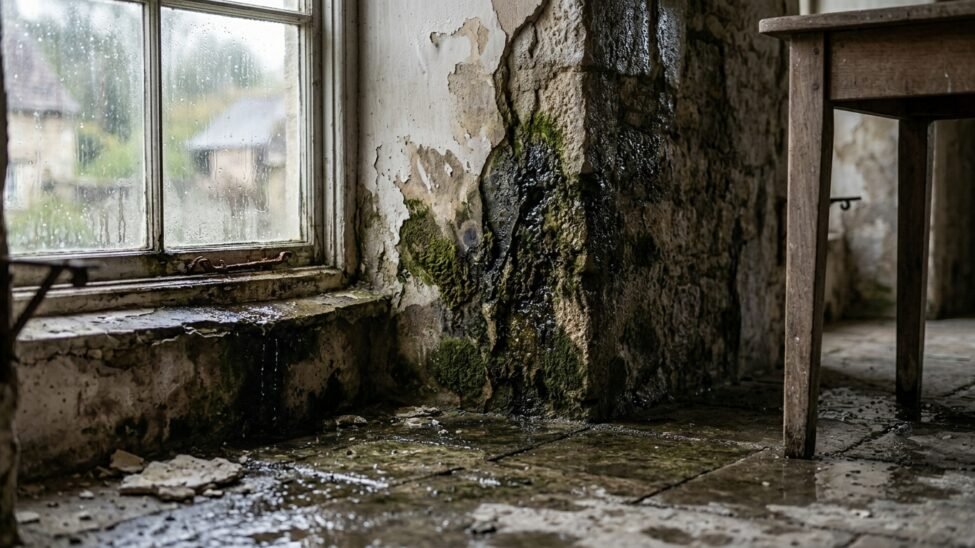
Locating and repairing a leaking pipe is only half the battle. If thousands of litres of water have slowly saturated your sub-floor, walls, or structural joists over several months, simply turning off the water won’t fix the problem. Trapped moisture can rapidly lead to secondary structural hazards, including destructive dry rot, wet rot, and toxic black mould outbreaks.
A comprehensive water investigation assessment ensures your property recovers completely:
- Structural Drying Guidance: A surveyor advises on the most efficient, controlled dehumidification and air-moving setups to draw moisture out of the building safely.
- Progress Monitoring: Ongoing moisture testing tracks the drying process to guarantee materials return to safe, pre-incident baselines.
- The Safe Sign-Off: A final independent inspection verifies that structural timbers and plaster are perfectly dry before your decorators or builders begin reinstatement work, ensuring you never trap dampness behind new finishes.
Stop the Leak Without Stopping Your Life
If you notice unexplained damp patches on your walls, hear water trickling when the taps are off, or have an ongoing dispute with an insurer or neighbour regarding water ingress, do not let contractors start demolishing your home to look for the answer.
Put data and technology on your side. Get a completely independent, professional, and non-destructive assessment that pinpoints the truth.
Contact Wiltshire Damp Survey today to schedule your expert leak detection or water damage assessment and keep your property safe, dry, and intact!