

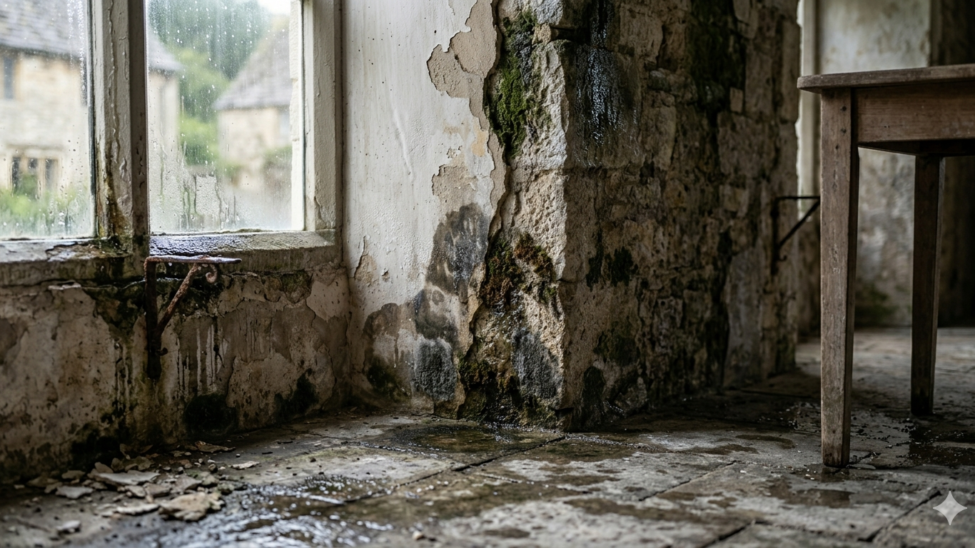
The Condensation Conundrum: Is It Lifestyle or a Building Defect?
If you manage or own a property, few things cause as much friction as a sudden breakout of black spot mould or peeling wallpaper. For landlords, it often triggers a frustrating blame game: the tenant insists the building has a structural defect, while the landlord or letting agent suspects the property isn’t being ventilated or heated properly.
When these disagreements escalate, they can ruin landlord-tenant relationships, lead to formal complaints, or result in costly, unnecessary repair bills.
The truth is that moisture issues can be incredibly deceptive. Simple condensation can easily mimic the appearance of rising or penetrating damp to the untrained eye. Here is how to break down the differences and why an objective, data-driven assessment is the only way to find a permanent solution.
1. What Exactly is Condensation?
Unlike rising damp (which pulls groundwater up through masonry) or penetrating damp (where rain water leaks through walls or roofs), condensation is generated entirely from inside the property.
It occurs when warm, moisture-laden air hits a cold surface—like an uninsulated external wall, a window pane, or a cold corner behind a wardrobe. When the air temperature drops rapidly at that surface, it reaches its “dew point” and drops its moisture as liquid water.
- The Daily Moisture Load: Everyday activities introduce an astonishing amount of water vapor into a home. A typical family of four can produce up to 10 to 15 litres of water a day simply through cooking, boiling kettles, showering, washing dishes, drying clothes indoors, and breathing.
- The Modern Trap: Modern home upgrades like double glazing, draft proofing, and blocking up old chimneys are brilliant for keeping heat inside and lowering energy bills. However, they also turn properties into airtight boxes. If that daily moisture load has no escape route, it will settle on the coldest surfaces it can find.
2. Condensation vs. Structural Damp: Spotting the Differences
While both issues cause surface staining and can eventually ruin plasterwork, they behave very differently.
+--------------------------+-------------------------------------+-----------------------------------+
| Feature                  | Condensation Vibe                   | Structural Damp Vibe              |
+--------------------------+-------------------------------------+-----------------------------------+
| Mould Growth             | Heavy black spot mould common      | Rare (salts often inhibit mould)  |
| Staining Pattern         | Widespread, patchy, corners/ceilings| Distinct "tide mark" or low bands |
| Surface Texture          | Damp but powdery when dry           | Often leaves crystalline salts    |
| Seasonal Behavior        | Drastically worse in winter months  | Persistent year-round or post-rain|
+--------------------------+-------------------------------------+-----------------------------------+
- The Black Mould Clue: Black spot mould (Aspergillus niger) thrives specifically on clean, condensed water. True structural dampness often carries ground salts or mineral deposits with it into the plasterwork. These salts act as natural inhibitors, making it surprisingly difficult for black mould to grow directly on a true rising damp patch.
- The Location Factor: If you see mould high up in the corners of a room, along the ceiling line, or hidden completely behind a bed pushed flat against an external wall, you are almost certainly dealing with a lack of airflow and high humidity (condensation). Rising damp is physically limited by gravity and rarely climbs higher than 1 to 1.2 metres from the ground level.
3. How Diagnostic Data Settles the Debate
Resolving a damp dispute requires moving away from guesswork and moving toward hard data. An independent damp surveyor doesn’t just look at a wall and make an educated guess; they map out the home’s internal environment using specialized, calibrated instruments:
- Relative Humidity & Dew Point Tracking: Using electronic thermo-hygrometers, the surveyor calculates the exact ambient air temperature, relative humidity (RH), and dew point inside the rooms. If the indoor humidity is consistently tracking above 60% to 70%, the property is highly primed for condensation.
- Surface Temperature Analysis: Thermal imaging and infrared thermometers locate “cold bridges”—areas where structural elements (like a concrete lintel over a window or a lack of cavity insulation) are significantly colder than the rest of the room, drawing condensation like a magnet.
- Sub-Surface Moisture Profiling: Non-destructive moisture meters read deep inside the plaster. If a wall is bone dry on the inside but wet on the immediate surface, it points directly to atmospheric condensation rather than an active structural leak.
Settle the Property Blame Game for Good
Whether you are a homeowner trying to get to the bottom of a stubborn mould problem, a landlord facing a housing standard dispute, or a tenant wanting a healthy living environment, guessing won’t fix the problem.
An independent damp report provides an unbiased, scientifically verified verdict. It outlines exactly what percentage of the issue stems from structural details and what requires simple lifestyle or ventilation modifications.
Stop guessing and start solving. Contact Wiltshire Damp Survey today to book an objective, expert condensation and damp investigation across Wiltshire and Swindon!